
Cybrilliant Talk to an Expert

Managed SOC and MDR, 24x7, in the UAE: Someone is always watching, and someone acts.

Our analysts watch your environment around the clock, investigate what looks wrong and act on what is real. You hear about confirmed threats with a clear next step, not a stream of raw alerts.

For

Organizations that cannot staff round-the-clock monitoring, or want a second team on top of their own.

You get

Continuous monitoring, investigation, a defined response action and reporting you can show leadership.

How it runs

We connect to your logs and endpoint tools, tune detection to your business, then run the loop.

Not included

Full incident response and recovery. We hand off to Incident Response when an attack needs it.

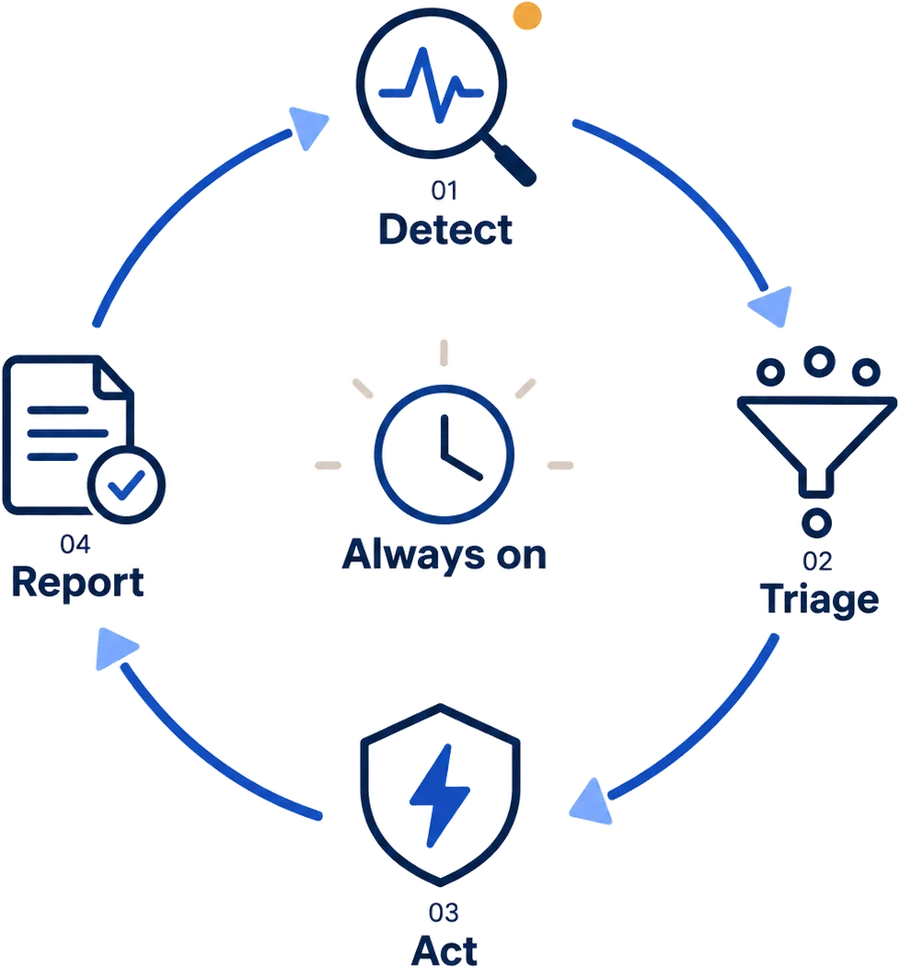
The watch loop

The same four steps run all day and night. What changes is how much each step knows about you.

Detect, triage, act and report: a four-step loop that repeats, with an always-on clock at the centre.
  • Detect

    Rules, behavior analytics and threat intelligence flag activity worth a look.

  • Triage

    An analyst decides in minutes whether it is noise, risk or an attack.

  • Act

    Isolate a host, disable an account or block an address, as agreed in advance.

  • Report

    You get what happened, what we did and what to change. Lessons feed new detections.

Sample alert as you would receive it (illustrative)

What we saw
A finance user signed in from a new country, then created a mailbox forwarding rule.
What we did
Disabled the session, reset the sign-in and removed the rule. Confirmed with the user by phone.
What we need from you
Approve a password reset policy for finance. Confirm the user's travel.
Why it matters
This is a common first step in invoice fraud.

Detection is where time is won

52%

of organizations first noticed the attack themselves in 2025, up from 43%.

Google Cloud, M-Trends 2026

22 seconds

median time from first access to hand-off to a second threat group in 2025, down from more than eight hours in 2022.

Google Cloud, M-Trends 2026

48%

of breaches in 2025 involved ransomware.

Verizon DBIR 2026

What we agree before go-live

A monitoring service is only as good as its written terms. We settle these first.

Coverage
Which systems, logs and locations are watched.
Response times
How fast we triage and escalate each severity.
Pre-approved actions
What we may do without asking, and what needs your sign-off.
Escalation
Who we call, in what order, at what hour.
Reporting
What you receive weekly, monthly and after an incident.

Three ways to run it

ItemIn-house SOCManaged SOC / MDRCo-managed
Who watchesYour staff, in shifts.Our analysts.Both, with clear lines.
Best forLarge teams with the budget to staff all hours.Teams that need coverage fast.Teams that want to keep control of tooling and some work.
Main riskGaps at night, on weekends and in leave.Less insight into your business without good onboarding.Unclear ownership if roles are not written down.

What you hold each month

  • Coverage mapWhich attacker techniques you can see, mapped to MITRE ATT&CK, and what you cannot.
  • Service reportAlerts handled, confirmed threats, response actions and trends.
  • Detection libraryThe rules written for your environment, with the reason for each.
  • RunbooksStep-by-step actions for the common attacks.
  • Improvement listGaps in logging and tools, ranked by value.

Works well with

  • Incident ResponseTakes over when a monitored alert turns into a live incident.
  • Threat HuntingLooks for what the rules missed.
  • Threat Detection & Detection EngineeringBuilds and tests the rules the SOC runs on.

Questions we hear

Do we need to buy a SIEM or an endpoint tool?

Not necessarily. We work with the tools you have and advise where a gap justifies a new one.

Will you act on our systems without asking?

Only for actions you pre-approve in writing, such as isolating a host. Everything else we recommend and you decide.

Where does our data go?

We agree data location and retention with you in the contract, with UAE residency options where your rules require them.

How long does onboarding take?

It depends on how many log sources and sites you have. We give a plan after a short discovery.

Put someone on watch tonight.

Tell us what you run and how it is monitored today. We show what changes.